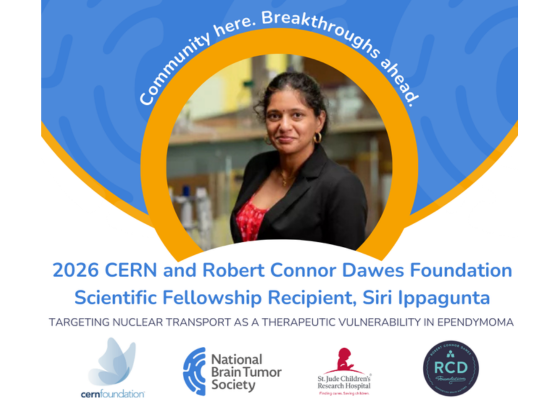
Under the mentorship of Dr Stephen Mack, Dr Ippagunta’s research will focus on Targeting Nuclear Transport as a Therapeutic Vulnerability in Ependymoma. This prestigious fellowship marks the beginning of CERN’s 20th anniversary year and reflects a shared commitment to advancing global ependymoma research and advocacy.
Advancing urgently needed treatments
Brain cancer remains the leading cause of disease-related death in children. One particularly challenging brain and spine tumour, ependymoma, has seen little change in treatment options for more than 30 years, with surgery and radiation still the primary approaches. Tragically, many tumours recur even after aggressive treatment.
New, more effective therapies are urgently needed.
Ependymoma is not a single disease, but a group of tumours with different subtypes, behaviours and outcomes. Dr Ippagunta’s work will focus on a specific and aggressive subtype known as ZFTA-RELA (ZR) driven ependymoma.
To study this disease, the Mack Lab has developed one of the first genetic mouse models of ZR-ependymoma. This model allows researchers to better understand how the cancer develops and to test potential new treatments in a laboratory setting.
Promising discoveries with real potential
Through earlier research supported by the National Brain Tumor Society, the Mack Lab discovered that ZR-ependymoma cells rely on a protein called Exportin 1 (XPO1) to survive. When this protein is blocked, tumour cells die.
This finding led the team to investigate Selinexor, an FDA-approved cancer drug that can cross the blood–brain barrier and safely inhibit XPO1. In laboratory studies using mouse models, Selinexor significantly reduced tumour growth and improved survival. Even more promising results were seen when Selinexor was combined with other drugs already tested in children with ependymoma, including Gemcitabine and Ribociclib.
“These findings suggest that blocking nuclear export could be a powerful new treatment strategy for children with this form of ependymoma,” the researchers note.
Looking toward clinical impact
Dr Ippagunta’s fellowship project will build on this work by testing Selinexor and related drugs in patient-derived models of additional ependymoma subtypes, and by studying how these treatments interact with radiation therapy. These critical studies aim to generate the evidence needed to design a new clinical trial for children with ependymoma in the coming years.
“Our goal is to bring new hope — and new treatments — to children and families affected by this devastating disease,” said Dr Siri Ippagunta. “Support from the fellowship will enable testing of these new treatments to optimise their translation to patients.”
A collaborative investment in the future
CERN Executive Director Kim Wallgren highlighted the importance of this collaborative funding model, saying, “The CERN Fellowship program was created to capitalise on the tremendous expertise in our leadership network. This unique round of collaborative funding builds on significant investment already underway at the Mack Lab and highlights an early-career scientist working under expert mentorship to further the field and build capacity in ependymoma research. This is an important, actionable step toward progress.”
In partnership with the CERN Foundation, the named fellowship is supported by the Robert Connor Dawes Foundation and awarded by the National Brain Tumor Society. Since 2018, the RCD Foundation has been a leading sponsor of the fellowship program, helping accelerate research momentum and support the next generation of scientists working to change outcomes for children with brain cancer.